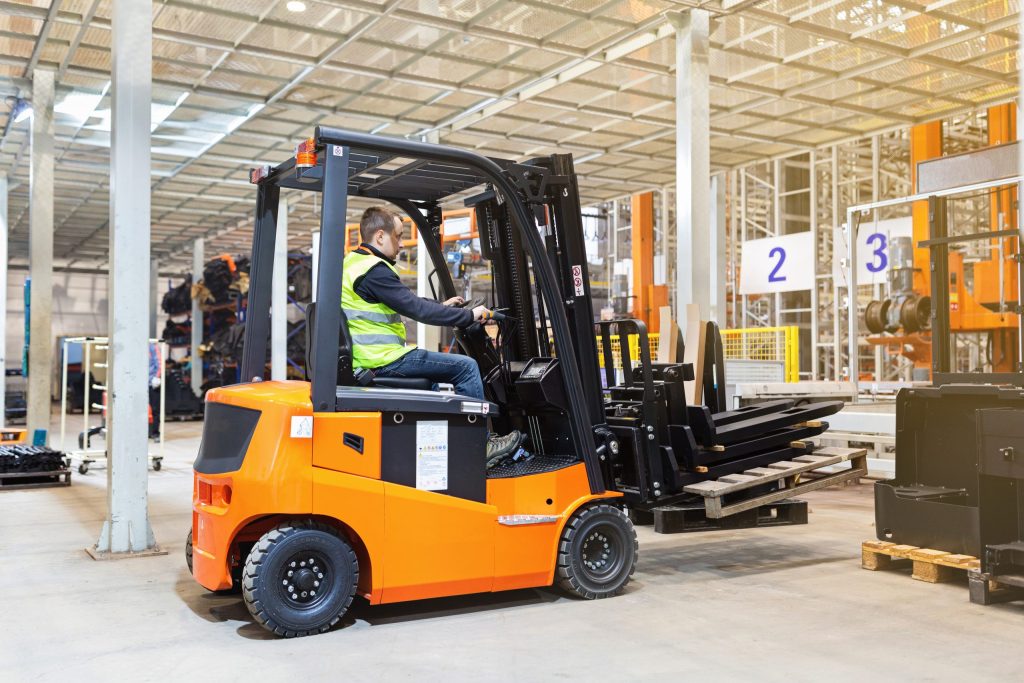
If you drive a forklift at work in BC, you need training that meets the CSA lift truck standard before you get behind the controls. KVES offers forklift operator training right here in Kitimat for new operators and for experienced operators who are due to renew.
Our courses combine classroom learning with a hands on driving evaluation, so you leave knowing how the machine works and how to use it safely on a real job site.

Standard
CSA B335 lift truck safety standard
Retraining
At least every three years
Format
Classroom theory, written test and practical evaluation
WorkSafeBC expects every lift truck operator to be trained to the CSA standard and to pass a test before operating a forklift on the job. Here is what that means for you and your employer.
Training comes first. No worker should operate a forklift until they have completed training and passed the test. Employers are responsible for making sure this happens.
Who can train you. Training can be delivered by your employer or by an outside provider like KVES, as long as it follows the CSA standard.
Keeping it current. Operators need upgrade training at least every three years. Our recertification course is built for exactly that.
Forklift safety in BC is set out in Part 16 of the WorkSafeBC Occupational Health and Safety Regulation, which points to the CSA B335 Safety Standard for Lift Trucks for training. These are the parts that matter most for operators and employers.
Section 16.43 requires lift trucks to be designed, used, inspected, maintained and repaired to CSA B335 (or the ANSI or ISO standard that fits the machine). Operator training must meet Clause 6 of CSA B335, which covers initial training, familiarization on new equipment and upgrade training.
Under section 16.3, operators must inspect the forklift before its first use on each shift, watch how it performs while working and report any unsafe defects. Employers must keep a record of reported defects for at least two years.
Section 16.31 requires a permanent rated load notice the operator can see and read. Forks and other attachments must be installed as the manufacturer specifies or certified by a professional engineer, with instructions for their safe use available to the operator.
A unitized load cannot stick up more than half its height above the fork carriage or backrest, and loose objects cannot stick up above it at all. Any load that could shift and make the truck unstable must be restrained.
Walkways should keep people separate from forklift traffic where practical. When that is not possible, sites need speed limits, eye contact before crossing or another effective control. If you cannot see where you are going, check on foot first or use a signaller.
Before stepping away from the controls, the forklift must be secured with at least two braking or parking means, such as the parking brake and park position. Elevated forks and loads must be lowered to a safe position first.
CSA released a new edition of the standard, B335:25, in April 2025. The BC regulation still names B335-15, so that is the edition WorkSafeBC enforces today. Our courses follow the CSA standard and are updated as the regulation changes.
You do not need any experience with heavy equipment to start. The course walks you through the knowledge first, then puts you on the machine with an instructor watching.
How a forklift stays balanced, how to read a load capacity plate, and the regulations that apply on BC work sites. A written test confirms you have the knowledge.
Checking the machine before every shift, spotting problems early and knowing when a forklift should be taken out of service.
Driving, lifting, stacking and placing loads while your instructor observes and coaches you, followed by a hands on evaluation of your skills.
Most people who struggle on the driving evaluation already know the theory. What trips them up are habits picked up on the job. Watch for these:
Many job sites in the Northwest ask for more than a forklift ticket. KVES also offers fall protection, confined space, H2S Alive and first aid training so your whole crew can get certified in one place.
See All CoursesFor new operators, or anyone who has never been formally trained. Covers theory, inspection and a full practical evaluation.
More InfoFor experienced operators whose training is coming up on three years. Refresh your skills and keep your certification current.
More InfoWorkSafeBC requires operators to receive upgrade training at least every three years. If your training is close to three years old, the recertification course is the one for you.
No. The operator course is designed for people with no previous forklift experience. You will learn the theory before you ever get on the machine.
No. WorkSafeBC does not require a licence or government certification to drive a forklift. What it does require is training to the CSA standard and a passed test before you operate one. The certificate you get from KVES is your proof of that training, so keep a copy for your employer.
Swapping out a propane cylinder does not need anything extra. If you will be transferring propane from one container to another to refuel, WorkSafeBC also requires a propane handler's certificate.
Yes. In BC, workers must be trained to the CSA standard and pass a test before they operate a forklift, and employers must make sure that training is in place.
Yes. Contact our Corporate Training team at 250-639-9199 or corporatetraining@kves.ca to talk about group bookings and dates that work for your crew.
Call our Corporate Training team at 250-639-9199 or email corporatetraining@kves.ca to book your seat.